
Criminal Court Cases in Obion County
Obion County divides local criminal work between Circuit Court and General Sessions. Circuit Court is the felony trial court. General Sessions hears misdemeanor cases and conducts preliminary felony proceedings before a bind-over or indictment moves a felony toward Circuit Court. Municipal courts handle city ordinance and citation matters, so a city ticket may never appear in the county criminal docket. The Circuit clerk is also the General Sessions clerk, but the counters occupy separate buildings on Bill Burnett Circle in Union City.
The clerk creates and maintains the official court case file. That file follows prosecution, not merely custody. It can contain the complaint or indictment, docket entries, pleas, motions, orders, the judgment, and sentencing material. An Obion County arrest record may show the allegation made at intake, yet the criminal court case can carry a changed, reduced, or dismissed charge. Search both court types when the procedural posture is uncertain.
The Tennessee courts clerk directory identifies the local court offices. Its Obion County listing helps distinguish the trial-court clerk from a municipal clerk before a request is mailed.
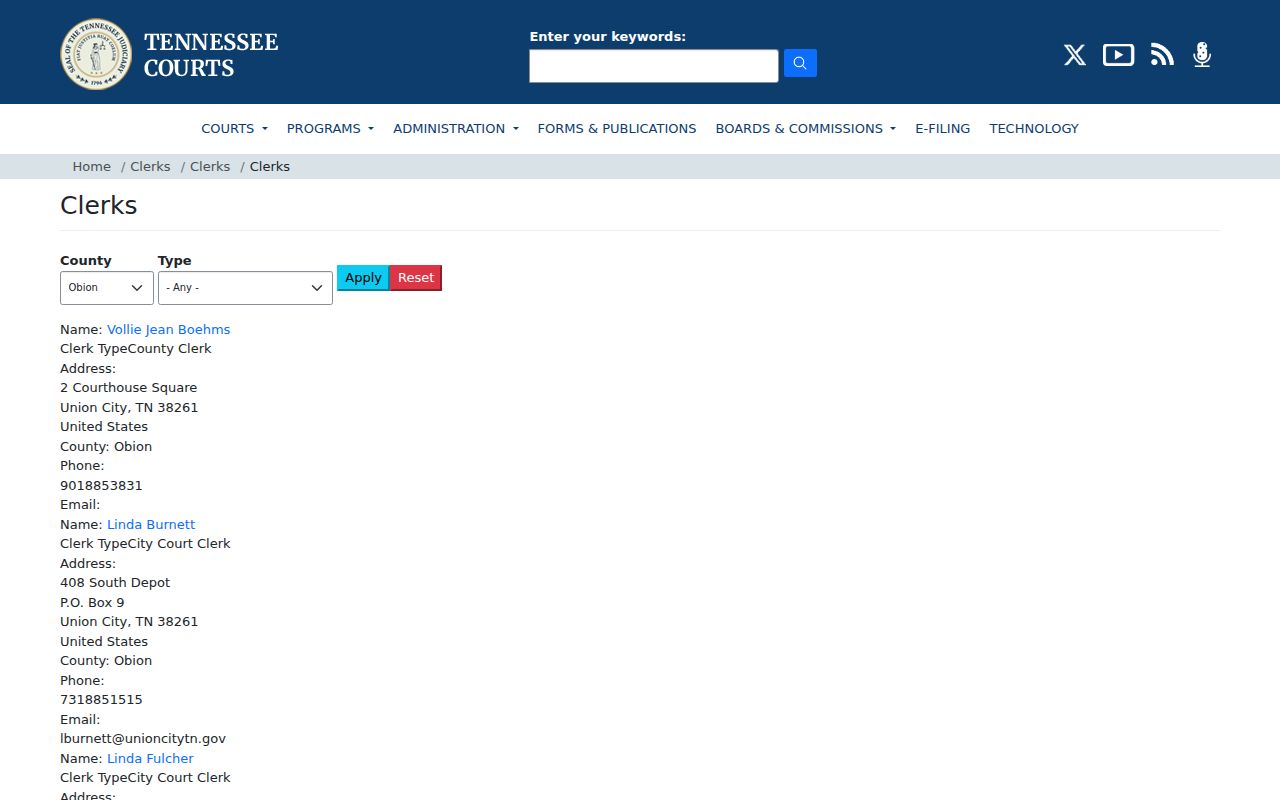
The directory view supports the basic routing rule: send a county criminal case request to the court that actually heard the charge.
Obion County Court Portal Fields
The Obion Online Court Records System places party names and case references in one main text box. Full first and last names work best. A quoted phrase can narrow the match, and the default “Match all search terms” setting limits loose results. Both Circuit and General Sessions are selected at first, as are Civil and Criminal. Uncheck Civil to keep the results tied to criminal court cases.
Case numbers need special care. For a reference such as 99GS1-2023-CR-12345, the separate Case Number field takes only the final numeric portion, 12345. The Case Year accepts no more than four digits. Turnstile verification is required before “Find Now” runs the query.
| Field Label | Type | Required | Options or Format |
|---|---|---|---|
| Party Name / Case Reference | Text | Conditional | Use a full name or reference; quoted phrases are allowed |
| Match all search terms | Checkbox | No | Checked by default |
| Case Year | Text | No | Four digits maximum |
| Case Number | Text | No | Enter the final numeric segment |
| Court Type | Checkboxes | At least one | General Sessions, Circuit Court, or both |
| Case Type | Checkboxes | At least one | Select Criminal; clear Civil for a focused search |
| Turnstile | Verification | Yes | Complete the human check |
Note: The public portal limits results to 2,500 rows, so a year, quoted name, or exact final case number can prevent an overly broad result set.
Obion County Case Record Searches
Start online for a filed Circuit or General Sessions matter. The portal has no public-login requirement, though it also displays a separate subscription login. Search Help explains its syntax, and results can be sorted by a column heading or narrowed with the on-screen Filter box. The portal does not publish a coverage start date, refresh schedule, copy fee, or download fee.
- Open the Obion portal and leave both Circuit Court and General Sessions selected when the court is not yet known.
- Enter a full party name or a case reference. Add the four-digit filing year or final numeric case segment when available.
- Clear Civil, keep Criminal selected, complete Turnstile, and choose “Find Now.”
- Open the result and read each charge, docket event, case status, and disposition rather than relying on the caption alone.
- Ask the correct clerk for the docket sheet, charging paper, judgment, disposition, sentencing order, or certified copy.
The Obion portal terms explain why the screen is an index rather than a guarantee. Online payment also serves a different task. CourtFeePay accepts Circuit and General Sessions payments and adds a 3 percent or $3 fee, but paying a balance does not retrieve a case file.
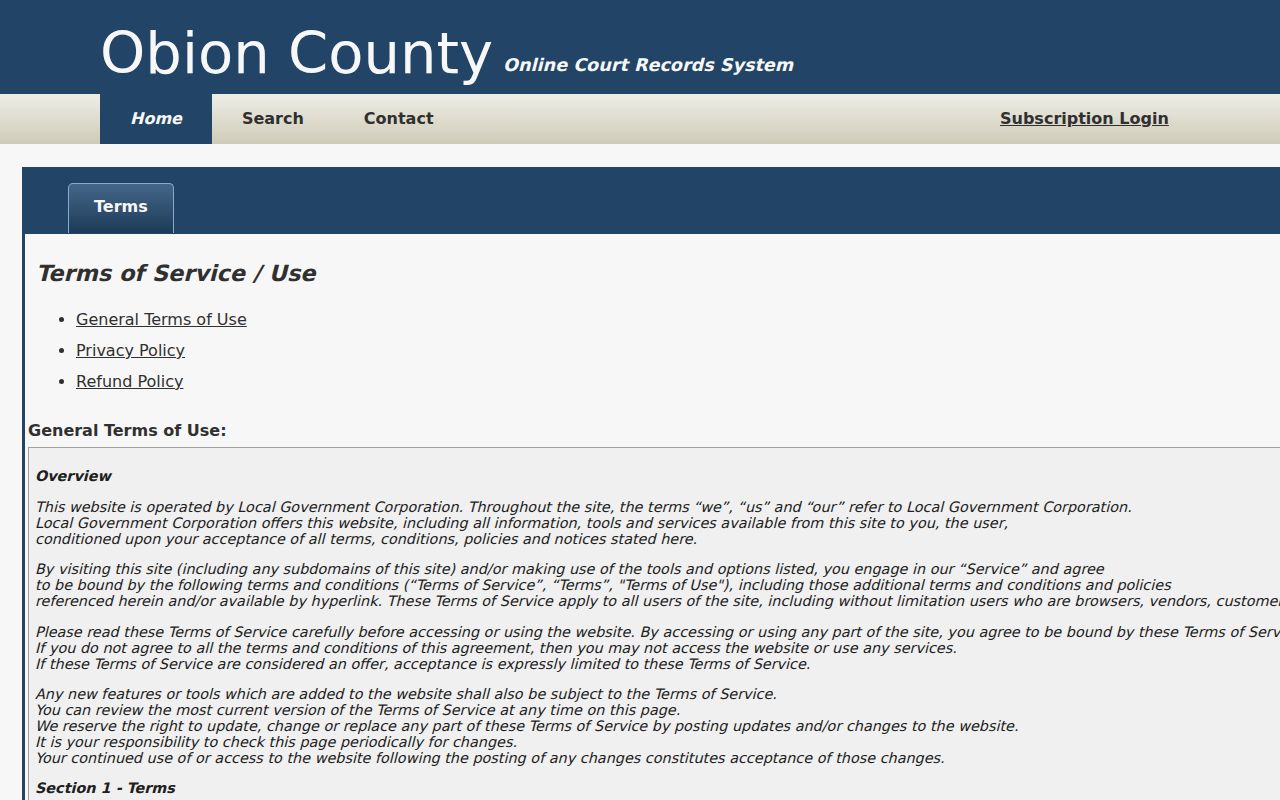
The terms screen reinforces the need to read the current docket and obtain a certified clerk copy when the exact court outcome matters.
Unindexed Obion County Court Cases
An older criminal case, a newly filed matter, or a record that does not match the name entered may require clerk help. Circuit Court is at 7 Bill Burnett Circle, PO Box 606, Union City, TN 38281. General Sessions is at 9 Bill Burnett Circle with the same mailing box. Both court offices publish weekday hours of 8:30 a.m. to 4:30 p.m. The shared main number is 731-507-0999. Choose extension 1, then 1 for Circuit; choose extension 1, then 2 for General Sessions.
Give the clerk a case number if possible. Otherwise provide the full name, approximate filing year, court type, and charge. Ask which copies exist, whether certification is available, what fee applies, and whether mail or another delivery method is offered. The official sources reviewed do not state a local copy schedule, so confirm cost before sending funds.
Circuit Court Clerk
7 Bill Burnett Circle
PO Box 606
Union City, TN 38281
731-507-0999, 1 then 1
Monday-Friday, 8:30 a.m.-4:30 p.m.
General Sessions Clerk
9 Bill Burnett Circle
PO Box 606
Union City, TN 38281
731-507-0999, 1 then 2
Monday-Friday, 8:30 a.m.-4:30 p.m.
What a Criminal Case File Contains
The criminal case file answers questions a booking page cannot. It identifies the prosecuting court, the charge actually filed, scheduled hearings, motions and orders, the plea or trial result, and any sentence. Financial entries may appear, but a balance alone does not explain the disposition. Read charge-level outcomes because one count may be dismissed while another ends in a conviction.
| Case Number & Court | Identifies the docket and whether Circuit or General Sessions maintains it |
|---|---|
| Charging Document | Shows the complaint, information, or indictment and the charge filed in court |
| Docket Entries | Lists filings, hearings, motions, orders, and other events in date order |
| Hearing Dates | Shows scheduled appearances and recorded court events |
| Disposition & Judgment | Records outcomes such as guilty, not guilty, dismissed, diversion, or nolle prosequi |
| Sentence & Conditions | States the court order after conviction, including any supervision or financial terms shown |
A docket is the dated list of case events. A disposition is the result of a charge. “Nolle prosequi” means the prosecutor formally chose not to continue that count. A “no true bill” means the grand jury declined to indict. Those terms do not mean the same thing, even though each can leave no conviction on that charge.
Obion County Charge Routing
A misdemeanor can be tried in General Sessions. A felony begins with early proceedings there, then may move after a grand jury indictment or bind-over to Circuit Court. Obion County’s grand jury is made up of thirteen members plus at least two alternates and ordinarily meets on the first Tuesday of February, June, and October. Special sessions are possible. A true bill is a formal accusation, not a finding of guilt.
A municipal citation follows a separate city-court route. By contrast, a state-law criminal charge belongs in the county trial system. This is why a Union City, South Fulton, or Troy payment page cannot stand in for the Obion criminal case portal. If the event began as an arrest, the related Obion County arrest search may help identify the arresting agency and booking trail before the filed charge is located.
Criminal Case Stages in Obion County
The precise path depends on the charge and the court. A complaint can begin the General Sessions record. A felony may then reach the grand jury and Circuit Court, while a misdemeanor may conclude in General Sessions. Motions and negotiated pleas can alter the path, and a trial may end in conviction or acquittal.
Case flow: Charges Filed › Arraignment › Pretrial › Plea or Trial › Disposition › Sentencing
Arraignment is the hearing where the charge is formally presented and a plea is taken. Disposition is the result of the charge. Sentencing follows a conviction, not a mere filing. An appeal creates a different record in the Court of Criminal Appeals, and the statewide appellate portal does not replace the Obion trial docket.
Obion County Criminal Case Appeals
The Tennessee Public Case History covers appellate cases filed after September 1, 2006 and is current through the prior business day. For later appellate filings, some motions, orders, judgments, and opinions may have linked PDFs. Search results can show the intermediate case number, style, trial court, trial judge, trial-court number, milestones, parties, counsel, disposition, and document history.
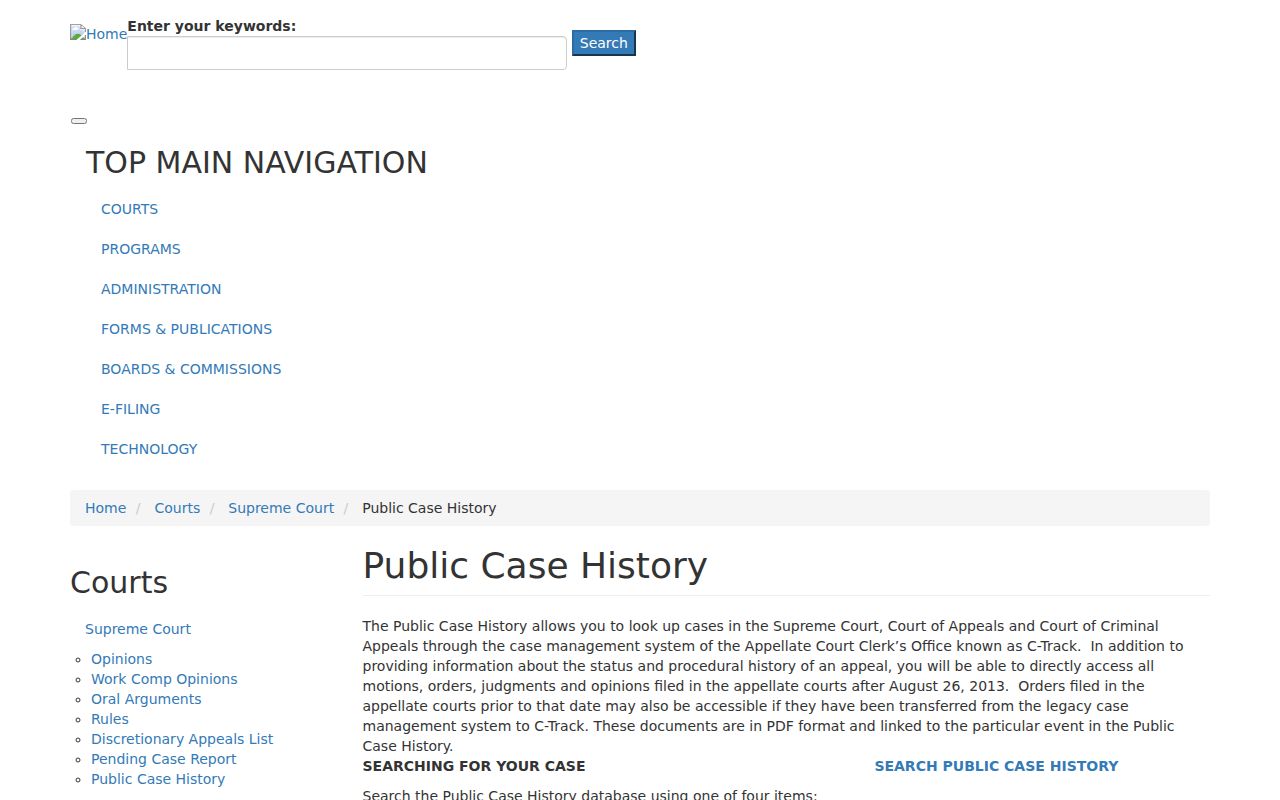
The statewide screen is useful only after an appeal exists. A trial-level Obion County court case still belongs in the county portal or the clerk’s file.
Reading Obion County Case Outcomes
A criminal case result should be read one charge at a time. TBI uses outcome labels such as Guilty, Not Guilty, Dismissed, and Diversion. Local dockets may also show pending, disposed, nolle prosequi, no true bill, acquittal, conviction, capias, or probation events. “Disposed” only means the court has completed an event or matter; the linked entry and judgment show how it ended.
- Diversion
- A statutory path that delays prosecution or judgment while a person completes set conditions.
- Capias
- Court process directing custody, often after a failure to appear or comply.
- Acquittal
- A not-guilty result after adjudication.
- Judgment
- The court’s formal ruling, which is more reliable than a bare status label.
When the portal and a TBI history disagree, obtain the judgment from the originating clerk. A missing disposition can be sent to TBI at TBI.Dispos@tbi.tn.gov or by fax to 615-744-4672. TBI may require a fingerprint card when its rejection code is “NC” or “NR.”
Access Rules for Case Records
Tennessee Supreme Court Rule 34 permits inspection of public court records but excludes records made confidential by law, sealed or protected material, unpublished draft decisions, judge-use copies not intentionally filed, and judicial conference material. Juvenile cases are ordinarily sealed. Public versions can also redact Social Security numbers and protected victim or minor information.
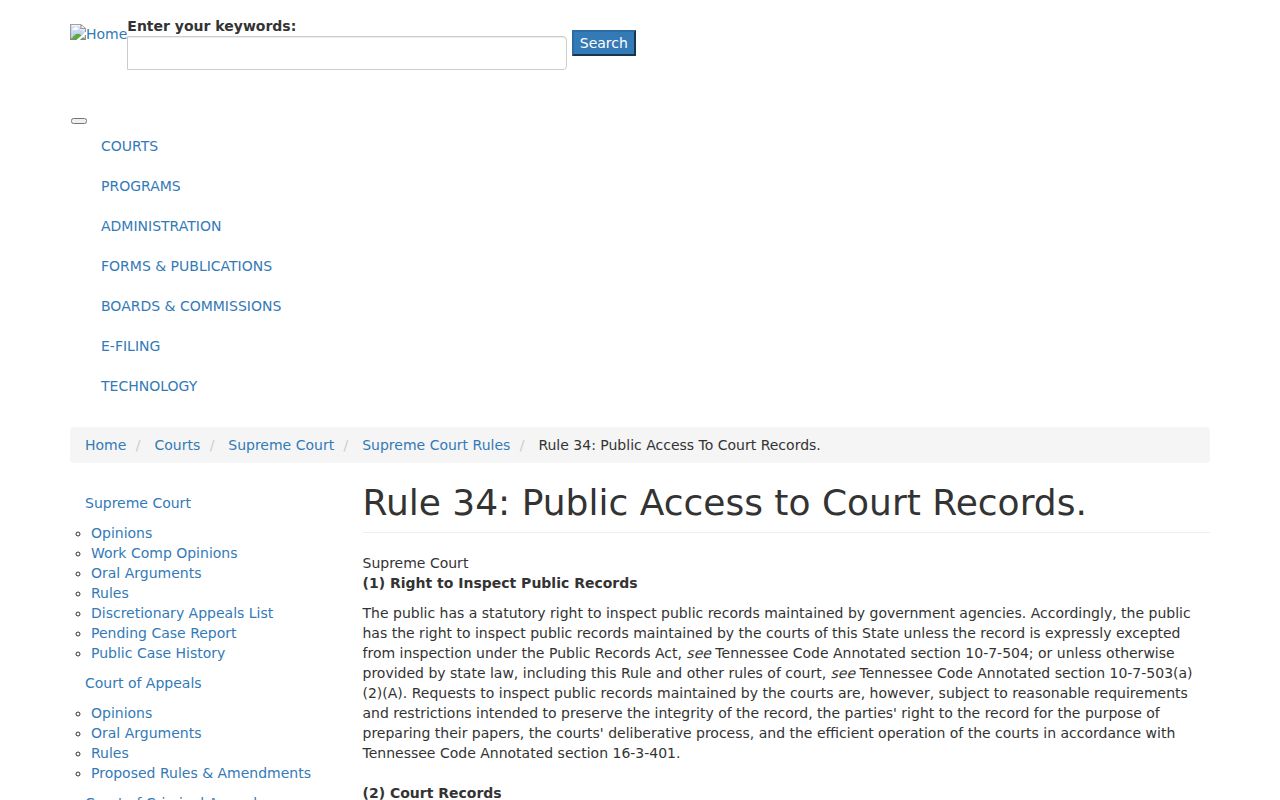
The rule explains why an online search can omit a document even when another part of the docket remains public.
Court visitors face strict local entry rules. Phones, purses, bags, briefcases, weapons, knives, food, and drinks are prohibited. Visitors are screened, and leaving may prevent reentry until recess. Calling the clerk before a records-counter trip can avoid bringing an item the courthouse will not admit.